


Custom Sizes. What to Do With Aftermarket Rims?
Custom Sizes. What to Do With Aftermarket Rims is really about one thing, where to find center caps for aftermarket wheels that fit your custom rims and stay put. I learned this the hard way on aftermarket wheels that looked perfect until I noticed four empty holes. The spokes were sharp, the lip was clean, and the center looked unfinished. I stood in the driveway thinking, how can a small part change the whole car this much.
Aftermarket wheel caps are not predictable. An OEM wheel usually has one cap size, one clip style, and a part number that every dealer can find. Aftermarket rims can share a style name while using different cap seats and different retention systems. And some wheels are made for caps that install from the back, which means the right answer is not guesswork, it is measurements.
Before you buy anything, decide what you are fixing. If the cap is missing or the clips are broken, you need a real center cap that locks into the wheel. If the cap still holds but the logo is faded, you can refresh the face with a wheel emblem sticker and skip the hassle of sourcing plastic caps. That one decision tells you which circle matters and which numbers you can ignore.
People waste money because they measure the wrong circle. They measure the wheel center bore, then order a cap, then wonder why it does not fit. Or they measure the outside face of a cap, then order a snap in cap whose clips are a different size. I did it once, and it felt like buying shoes by measuring the box.
Pick your path first
I use two paths, and I never mix them. If you mix them, you end up with parts that almost fit and nothing that looks right. Pick the path that matches your situation. Then follow it through.
Path one, your caps stay in place and you only want a clean logo, so you measure the visible face diameter and buy stickers sized in millimeters.
Path two, you need aftermarket wheel caps because the wheels have no caps or the caps fall out, so you measure the wheel cap seat and the retention style before you shop.
If you sell the car later, both paths are reversible. Stickers peel off with patience and gentle heat. Caps can be replaced again later. That is why I like these upgrades, they are low risk and high impact.
The four measurements that solve most problems
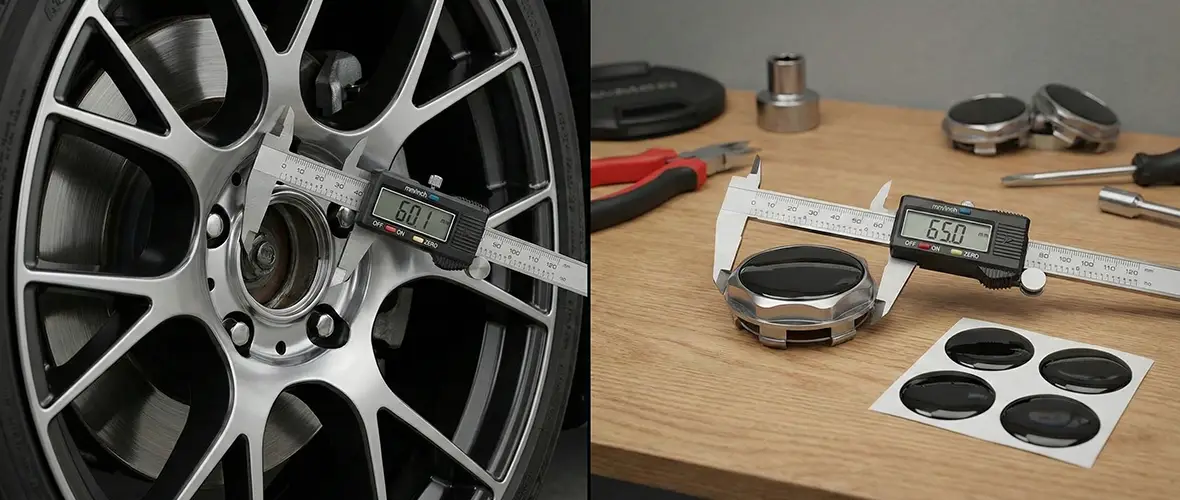
When I am working with custom rims, I take four measurements and I write them down. I do not trust memory because I always forget the exact number. A digital caliper makes this easy. If you do not have one, borrow one because a ruler is not accurate enough for a tight cap fit.
Visible face diameter, the flat circle you see when the cap is installed, and the number you need for a wheel emblem sticker.
Cap hole diameter, the wheel opening where the cap sits, and the most important number for replacement caps.
Clip to clip inner diameter, the distance across the retention clips on the back of a snap in cap, and the number that controls tightness.
Clip depth, the length of the clips, and the number that decides if the cap can reach the wheel groove.
If you only want stickers, you can focus on the visible face diameter. If you need a cap, start with cap hole diameter and retention style. The rest is fine tuning. Writing the numbers down saves you from repeat mistakes.
Retention style is the part that makes or breaks the fit
The wheel brand matters, but retention style matters more. A cap can be the right diameter and still fail if the wheel expects a different locking method. That is why I always identify retention style before I order. When you do this, you stop buying hope and start buying parts.
Here are the retention styles I see most often on aftermarket rims. You do not need to memorize the names. You just need to match what you have in your hand. Once you spot the style, sizing gets much easier.
Snap in with spring clips, the cap has flexible fingers that grab a groove inside the wheel.
Bolt in, the cap is held by small screws from the front or the back.
Threaded, the cap twists in, and the wheel has matching threads.
Push through, the cap installs from the back side of the wheel, so you often need the wheel off the car.
If you are not sure, do two quick checks. First, look for screw holes on the cap or the wheel. Second, try to rotate the cap gently, a threaded cap wants to twist, a snap in cap wants to pop. If you cannot move it at all, it is often bolt in.
Where to find center caps for aftermarket wheels
Where to find center caps for aftermarket wheels depends on one thing, do you know the wheel brand and model. If you know it, start with the source closest to the wheel maker. If you do not know it, start with measurements and use universal options. Either way, your goal is the same, match the numbers and match the retention style.
This is the sourcing order that saves the most time. It starts reliable and moves to flexible. I use it because it keeps the search simple and focused. When you follow this order, you avoid endless scrolling.
Wheel manufacturer support, ask for the center cap part number for your wheel model.
The shop that sold the wheels, many shops can pull caps through their supplier even when you cannot find them online.
Replacement cap sellers, these are great when your size is common and your retention style is standard.
Universal blank caps, these work when you have a common hole size but the brand cap is gone or overpriced.
Keep the cap, refresh the face, if your cap fits well and you only need the logo to look new.
If you are focused on appearance more than plastic branding, universal blank caps plus a good emblem is hard to beat. It fills the hole, it looks intentional, and it avoids waiting on a rare part. It also works on custom rims without an OEM style cap. You still measure first, but you get more options.
The smart way to use universal blank caps
Universal caps are only universal inside a narrow set of sizes. If you treat them like one size fits all, you will waste money. If you treat them like blanks that still need measurements, they solve a lot of problems. The cap still has to match the hole and the groove.
When I choose a blank cap, I check three things. I want the cap hole diameter to match, I want the clip depth to match, and I want the cap face to be flat enough for a sticker. A flatter face gives you cleaner edges and fewer bubbles. A very curved face can work, but it needs a sticker that can flex and a careful install.
If you already have caps that fit and you only want the logo cleaned up, start with the sizes and finishes in the sticker collection. You measure the visible face, pick the closest size that fits inside the flat area, and the wheel looks new again. It is the fastest upgrade for custom rims. It also costs less than replacing caps.
Simple driveway routine to measure without damage
You do not need a workshop. I have done this with a flashlight. The key is to take the cap out carefully so you do not crack the plastic or scratch the wheel. Measure the cap in your hand whenever you can.
Pop one cap out gently, or remove the wheel and push the cap from the back if it is a push through style.
Measure the cap hole diameter on the wheel, this is the opening where the cap seats.
Measure the clip to clip inner diameter on the cap, if it is snap in.
Measure the visible face diameter on the cap, this is the number for your sticker.
Measure clip depth, then compare it to the wheel groove depth.
If you want a clean walkthrough of the measuring points and what each number does, use this guide: Stop Guessing. How to Measure Wheel Center Caps Correctly. It is a better use of your time than ordering three wrong sizes. It also helps you separate sticker sizing from cap sizing. That separation is where most beginners slip.
Common fit problems and quick fixes
Even when you measure, you can run into small issues. That is normal with aftermarket rims because tolerances and wear vary. The key is to diagnose the problem instead of forcing the part. Forcing is how you crack caps and chip paint.
Cap falls out, the clips are too small, too weak, or the wheel groove is worn, so you need a tighter clip to clip size or a different retention style.
Cap will not seat, the cap hole diameter is slightly smaller than the cap body, or the clips are too long and bottom out.
Cap sits crooked, the cap is hitting a lip or a ridge inside the wheel before the face can sit flat.
Sticker edge lifts, the face was not cleaned well, or the sticker is too large for the truly flat area.
If the cap is loose, do not glue it as your first move. Glue makes future service harder and can damage the wheel finish when you remove it. Fix fit first, then lock it in. When fit is right, the cap feels like it belongs there.
Installing wheel emblem stickers so they last
A sticker is simple, but it still needs proper prep. Wheels see heat, water, and brake dust. A good adhesive can handle that, but only if it bonds to a clean surface. That is why I treat installation like a process.
Wash the cap face with mild soap and water, then dry it fully.
Wipe the face with isopropyl alcohol, then let it dry for one minute.
Dry fit the sticker without peeling, confirm it sits inside the flat area.
Peel and place, then press from the center out with firm pressure.
Press the edges again, then avoid washing for a full day.
If you want more mistakes to avoid, especially the ones that cause bubbles and peeling, read this one next: Avoid These 5 Common Mistakes When Applying Wheel Decals. Most failures are not about the product. They are about rushing the prep. A calm install beats perfect tools.
One example product so you know what to look for
When people hear aftermarket wheel caps, they picture a thick plastic part only. In reality, the most visible part is the face, and that is what you can upgrade fast on custom rims. A good listing shows diameter in millimeters and tells you what the material is, so you can match the measurement you wrote down. This page is a clear example of that approach: Chevrolet Wheel Emblems Version Premium Label Design.
If you want a different look, a domed build adds depth and hides small scuffs on the cap face. This is another example that makes sizing simple: Dodge Resin Domed Stickers Exclusive Design High End Badges. The brand name is not the point, the clarity of sizing and the quality of surface prep is the point. When the cap fits tight and the face is clean and flat, the result looks like it belongs on the wheel.
The bottom line
Aftermarket rims reward people who measure. If you measure the cap hole diameter and the retention style, you can find the right aftermarket wheel caps without wasting money. If your caps already fit, you can refresh the look with the right size sticker and make your custom rims look finished again. Do it once, write down the numbers, and you will never guess again.
Quick Q and A
Q: Why do aftermarket wheels have so many center cap sizes?
Aftermarket wheels are made to fit many cars, and different wheel models use different cap seats and retention methods. That is why there is no single universal size. Measuring the wheel cap hole beats guessing.
Q: What measurement matters most for replacement caps?
Cap hole diameter on the wheel is the gatekeeper number. If that is wrong, the cap will not seat. Then retention style and clip depth decide if it stays in.
Q: What measurement matters most for stickers?
Visible face diameter is the key, because the sticker sits on what you see. Choose a size that stays inside the flat area so the edge does not lift. Clean and press firmly for best bond.
Q: Do I need hub rings to make my center cap fit?
No, hub rings are about centering the wheel and reducing vibration. Center caps are held by clips, threads, or screws. Treat them as separate parts with separate measurements.
Q: How long should I wait before washing after applying a wheel emblem sticker?
Wait one full day. The adhesive bonds quickly, but it gets stronger over time. Giving it twenty four hours makes the edge hold much better.


