


The 68mm Standard. Why Most BMWs Use This Size
68mm caps are the closest thing BMW has to a wheel center cap standard, and yes, most BMWs use this size. I learned it on a cold driveway with a caliper in one hand and a cap rolling toward the street. BMW stuck with 68mm for years because it fit a ton of factory wheel designs and it kept parts simple. That is why the number shows up everywhere when you start shopping.
A friend bought a used 3 Series that looked sharp from ten feet away, then sad up close. The wheel faces were clean, but the center caps were faded and peeling like old phone screen protectors. We ordered “BMW caps,” pushed them in, and one of them sat proud like a hat that is too small. Two days later the proud one was gone and the wheel looked like it had a missing tooth.
Here is the honest review of the title, the 68mm standard is real, but it is not a promise. BMW used 68mm on a huge range of cars and wheels for a long stretch, so it became the default answer. At the same time, many newer BMW wheel designs use 56mm parts, so you cannot treat 68mm like a guarantee.
If you want a cap that clicks in and stays there, you measure first and you stop guessing.
What 68mm actually means
Most people think 68mm is one measurement and one part. A cap has a face diameter you see from the front and a mounting diameter on the back where the tabs lock in. Those numbers can be different, and that is where people waste money. Some listings even spell it out by pairing an outer 68mm size with an inner mounting diameter in the mid 60s.
This is why you can buy a “68mm” cap and still have it fit wrong. If the mounting ring is off, the cap will not seat flush, or it will seat and then leave you later. If the face is right but the mount is wrong, it can look perfect in your hand and fail on the wheel. It feels unfair, but it is just how these parts work.
Here is the quick way to think about it. 68mm is usually the face size you see. The back mounting ring decides if it stays in. The flat badge area is its own number because stickers need flat land.
Face size is what you see, and 68mm is common on many BMW wheels.
Mount size is what locks in, and it is often smaller than the face size.
Badge area is the flat land where a sticker or domed emblem sits.
That third point is sneaky. A lot of BMW caps have a raised lip, so the flat land is smaller than the full face. If your sticker hangs over the bevel, the edge lifts, then dirt and water finish the job. Measure the flat land and the emblem will sit like it belongs.
Why BMW leaned on 68mm for so long
BMW did not pick 68mm because it is magical. They picked it because standard parts make life easy and they had decades of wheel styles to support. When a brand uses one main cap size across lots of wheels, dealers stock fewer parts and owners can replace a missing cap fast. You can see that mindset in genuine BMW parts that are sold as 68mm complete snap in caps.
There is also a practical reason. 68mm gives enough room for the roundel to read clearly on a busy wheel, and it leaves space for strong tabs and a tension ring. It is big enough to feel solid and small enough to fit in a lot of wheel designs. That is why it became the size you keep running into.
The era split, and why newer BMWs can be 56mm
Most of the “BMW equals 68mm” talk comes from older generations and early modern generations that are still everywhere. Fitment guides list long runs of 68mm across many models, which matches what people measure on factory wheels. That repetition turned 68mm into the default shopping answer. It is a solid default when the wheels are stock and the car sits in that older range.
Then you hit the newer platforms and the story changes. Some size guides show a switch to 56mm on newer entries, including newer G chassis models and some newer M cars. A retailer note for newer G chassis caps even calls out a 56mm emblem and a wheel hole around 57mm to 58mm, and it warns that it will not work on older cars.
That is the part that saves you from buying the wrong set just because the car badge says BMW.
If you are driving a newer BMW, or if your wheels came from a different car, treat 68mm as a guess and not a fact. If you are driving an older BMW on stock wheels, 68mm is still the most likely answer. Either way, one quick measurement ends the debate. It also keeps you from paying shipping twice.
The three numbers that solve the whole problem
If you want a clean answer to what size are standard BMW wheel caps, you need three numbers. I ask for these because they cover the cap, the wheel, and the emblem area. Once you have them, shopping gets boring, which is the best outcome. Boring is good when you are buying small parts.
Outer face diameter of the cap
Back mounting ring diameter where the tabs sit
Flat badge area diameter on the front
If you only do one measurement, do the back mounting ring. That is the number that keeps the cap in the wheel. A perfect face size does not matter if the tabs do not lock. The face size is the easy part, the mount is the trap.
How to measure without scratching anything
Do the measuring with the cap out of the wheel and on a table. A digital caliper is cheap and it is the fastest way to avoid the one millimeter mistake. I also like to clean the edge first, because packed dirt can change what your caliper reads. If you want a full walk through with the common mistakes, use this measuring guide.
Here is my routine, and it takes about two minutes. I do it the same way every time so I do not guess. The goal is repeatable numbers, not a lucky number. Once the numbers repeat, ordering is easy.
Pop one cap out gently, and do it from the back if you can.
Clean the cap edge and wheel bore with rubbing alcohol, then let it dry.
Measure the outer face diameter across the widest point, then repeat once.
Flip it over and measure the back mounting ring where the tabs sit.
Measure the flat badge area on the front.
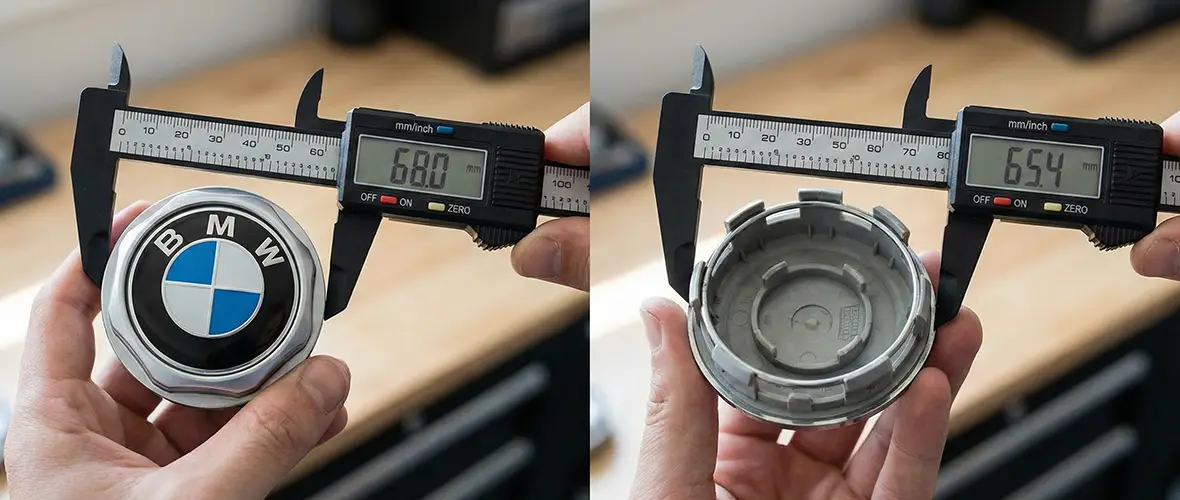
If your numbers land on common sizes like 68mm or 56mm, you are in normal territory. If you get a weird decimal, measure again and make sure the caliper is flat and not riding the bevel. The best measurement is one you can repeat three times in a row. That repeatable number is the truth.
When 68mm BMW center caps do not fit
When someone says my BMW is weird, I believe them, because wheels get swapped all the time. A used BMW can have factory wheels from another trim, a winter set, or aftermarket wheels that use a different cap system. Your car is BMW, but your wheels may not be “BMW standard” anymore. That is why the cap size can surprise you.
Here are the usual reasons a 68mm cap does not snap in. Most of them are wheel issues, not car issues. That is why guesses fail on used cars. The wheel in front of you is what matters.
The wheel is built for 56mm caps, which is common on newer BMW wheels and some newer models
The wheel is aftermarket, so the mounting bore and tab design do not match OEM
The listing headline is the face size, but the mounting ring is the real mismatch
The tension ring is missing or bent, so the cap feels loose
Dirt, paint, or corrosion in the wheel bore stops the tabs from seating
Clean the wheel bore before you call it a size problem. I have seen bores packed with old wax and dirt like someone stuffed it with gray toothpaste. Once you clean it, the cap can click in like it should. If you force it in while dirty, you can shave the tabs and make the next cap loose too.
Charts help, but your caliper is still the boss
Charts are great for a first guess. They are useless when the wheels are swapped. I check this BMW size chart to get close, then I measure one cap. If the caliper disagrees, I trust the caliper.
The badge fix, because the cap is often fine
A lot of BMW caps are still solid on the back, the front just looks cooked. The plastic snaps in tight, but the roundel is faded, bubbled, or peeling. People talk about this so much that common BMW emblem overlay sizes like 65mm, 68mm, and 70mm get mentioned again and again in DIY guides. If your cap still clicks in tight, you can keep it and just refresh the face.
This is the shopping path that saves money. It keeps you from buying full caps when the plastic is fine. It keeps the fit because the original cap still clicks in tight. You are just fixing the face everyone sees.
Measure the flat badge area, not the full cap diameter.
Pick a fresh overlay Stickers if you want a simple refresh.
Pick a deeper look from Domed Emblems if you want more depth and a tougher surface.
If you want a ready to go BMW option, a product like BMW domed badges gives you the depth look without buying new caps. It is a good move when the cap still clicks in tight but the front looks tired. Measure the flat badge area first so you buy the right diameter. Just remember, the badge size is the flat land size, not the 68mm cap face size.
My install routine that keeps stuff stuck
Most failures come from dirt and rushing. Clean the surface, line it up once, and press like you mean it. Then leave it alone for a bit and do not go straight into a car wash. It sounds boring, but boring is what lasts.
Here is the routine I use. It is not fancy, but it works because it respects the adhesive. The goal is full contact with no dirt under the edge. If you do that, it stays put.
Wash the wheel area and dry it fully.
Clean the cap face with rubbing alcohol and let it dry.
Test fit the cap without force and confirm it seats flush.
Apply the overlay once, then press from center to edge for about thirty seconds.
Do a final edge press, then give it some time before hard driving or washing.
If it is cold out, warm the cap and emblem in your hands first. You are not trying to melt anything, you just want the adhesive to feel ready. That small step makes the press feel smoother and it helps the edge stay down. Cold parts feel fine in your hand, but the glue acts sleepy.
Quick Q and A
Q: Are 68mm caps standard on every BMW?
No. They are very common across many models and wheels, especially older and early modern generations, but many newer wheels use 56mm parts. Measure one cap and you will know in minutes.
Q: What is the difference between 68mm face size and the mounting size?
Face size is what you see from the front. Mounting size is the back ring where the tabs lock into the wheel, and it can be smaller than the face size.
Q: My cap face is 68mm, but the wheel hole looks smaller. What is going on?
You may have a wheel designed for 56mm caps, which is common on newer BMW wheels and newer models. Some sellers even list the wheel hole size range for those newer caps, which is why the parts do not cross over.
Q: Can I replace just the BMW logo instead of the whole cap?
Yes, if the cap still snaps in tight. Measure the flat badge area on the face and buy the overlay that matches that number, not the full cap diameter.
Q: Why do my center caps keep falling out?
Wrong mounting diameter is the big one. Missing tension rings, dirty wheel bores, and worn tabs also cause it. Clean, test fit, and do not force it.
68mm is common on BMWs because BMW made it common, but your wheel does not care what the internet thinks. Measure one cap, match the face and the mount, and you get that clean click that tells you the job is done. If your BMW uses 56mm, do the same thing and match it before you buy. Once you do it once, you stop guessing.


