


Carbon Fiber Look. Why It Suits German Sedans
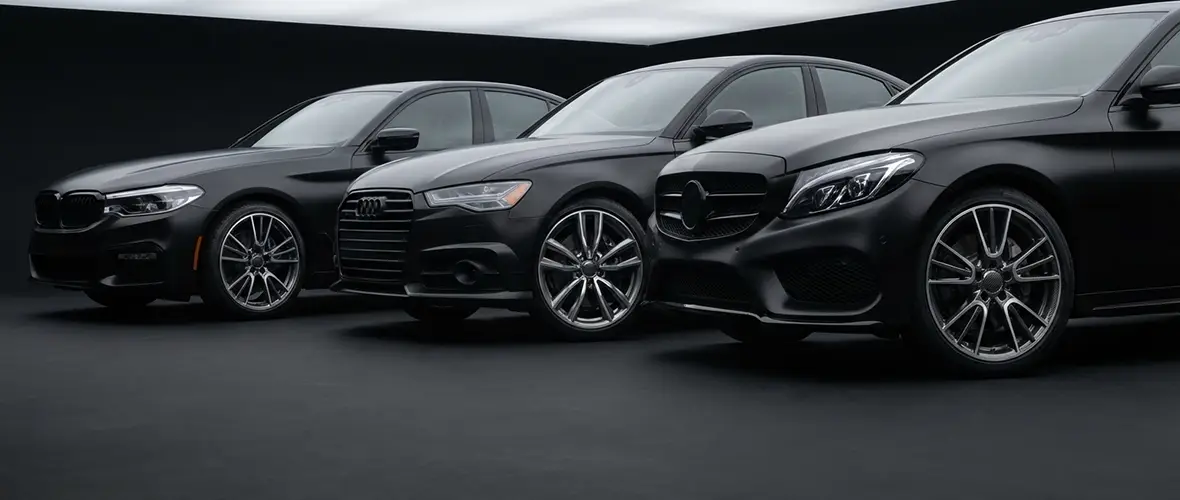
Short carbon fiber details are one of the fastest ways to make a German sedan look sharper, and the title is accurate because the pattern matches the way BMW, Audi, and Mercedes design their cars. German sedans lean on clean body lines, tight panel gaps, and calm surfaces, so a technical weave texture adds character without adding visual chaos. The carbon look also fits the performance story these brands sell, especially when the car has sporty trims, dark wheels, or gloss black accents. When you place that look on the wheel center, it reads like an OEM sport package choice rather than a random add on. Done right, it is subtle from ten steps away and satisfying up close.
Why German sedans make carbon fiber feel “right”
German sedans are built around proportion and restraint, so you can add a texture and still keep the whole car quiet. That is why carbon accents keep showing up on factory options and accessory catalogs, from mirror caps to aero parts. BMW M Performance Parts, for example, highlights carbon fibre components like front attachments, grilles, rear spoilers, and mirror caps as a motorsport style statement that stays aligned with the vehicle design. That matters because the carbon look is not only a pattern, it is a design cue associated with sport trims.
Here is what carbon fiber look adds to a German sedan without fighting the car:
• It introduces a high tech texture that still reads “neutral” in black and graphite tones
• It complements gloss black window trim, grilles, and dark wheel finishes
• It makes sporty packages feel cohesive, especially on M, AMG, and S line style builds
• It gives the eye a focal point that is not a bright color, so the car still looks mature
• It scales well, meaning it can be tiny on a wheel cap or larger on mirror caps without looking cheap
The key is scale and placement. A carbon look on an entire hood can be loud, but a carbon look inside the wheel center can be tasteful, because the wheel already has high contrast elements like spokes, brake hardware, and shadows. You are basically adding a texture inside a circle that the eye naturally checks when the car is parked.
The wheel center is where the “package look” lives
The center cap is one of the few spots you see every single day, even when the car is dirty. It is also where small mismatch issues stand out, like a faded emblem, a yellowed clear layer, or a different finish on one wheel. That is why a carbon fiber look approach often works best as a wheel center upgrade first, then everything else later.
If you want to browse styles before you commit, start with the main sticker catalog and the two wheel focused collections: Stickers, Wheel Emblems, and Domed Emblems. These categories are where you can match finish, size, and surface style without changing wheels.
A clean wheel center “package look” usually comes down to a few decisions:
• Gloss or matte, matched to the wheel finish
• Neutral tones, so the pattern is the detail, not the color
• A pattern scale that fits the wheel diameter and spoke density
• A material choice that survives brake dust, heat, and winter wash cycles
• A repeatable install method, because alignment is everything on a circle
If your car is a black, gray, white, silver, or deep blue German sedan, carbon look is basically a universal match. Those paint colors already sit in the same visual family as carbon textures.
Short, mid, and long weave styles, what the keywords really mean
People use carbon fiber terms loosely, but on wheels the practical meaning is pattern scale and how busy it looks at arm’s length. You can treat the three keyword phrases as three levels of weave presence.
short carbon fiber
Short carbon fiber reads as a tight, small weave. It looks almost like a technical fabric from a distance, which is why it suits daily driven German sedans. It blends with dark wheels and does not dominate the design, even on large diameter wheels.
Short weave usually looks best when:
• The wheel has many thin spokes, because the weave stays calm in small gaps
• The car already has gloss black accents and you do not want more shine
• You want a “factory sport” feel, not a track cosplay vibe
• You drive in winter, because small weave hides micro dirt and water spots
If you are not sure what to pick, short weave is the safe choice for most BMW 3 Series, Audi A4, and Mercedes C Class builds.
mid carbon fiber wheel caps
Mid carbon fiber wheel caps are the sweet spot when you want the weave to be obvious up close, but still quiet at normal viewing distance. The pattern reads clearly inside the circle, which gives you that premium tech feel without needing any other carbon parts on the car.
Mid weave usually looks best when:
• The wheels have fewer, thicker spokes, because the center area is more visible
• Your trim is a mix of gloss and satin, not fully matte or fully chrome
• You want the wheel center to pop a bit at car meet distance
• You plan to add one more carbon look detail later, like mirror caps
This is the “confident but not loud” option, and it fits the German sedan personality well.
Real carbon fiber vs vinyl wheel stickers
Real carbon fiber vs vinyl wheel stickers is the real durability and cost conversation. Real carbon fiber parts are composite components, built for strength and low weight, and they are used in motorsport and in production cars as premium visible components. BMW has been very public about composite development, including carbon fibre reinforced plastic in performance parts, and now even natural fibre composites intended to replace conventional carbon fibre components in visible areas like roofs, with a lower CO2e footprint in production.
Vinyl wheel stickers are about styling. High quality automotive wrap films are designed to conform and last outdoors, and manufacturers describe multi layer cast films and adhesives that support repositioning and bubble reduction. 3M’s Wrap Film Series 2080 is described as a multi layer dual cast film with Comply and Controltac adhesive technologies and air release channels aimed at vehicle wraps and accents. ORAFOL’s ORACAL 970RA is also described as a multi layered cast film made for car wrapping with strong dimensional stability and gloss retention.
On wheel centers specifically, the win is not “real” versus “fake.” The win is “stable, clean, and durable” versus “cheap, faded, and peeling.”
Material reality check, what lasts on wheels
Wheels live a rough life. They see brake dust, salty water, fast temperature swings, and aggressive cleaners. That means your material choice has to survive chemistry and heat, not just sunlight.
Here is how to think about carbon look materials for wheel centers:
• Real carbon fiber parts look premium, but they are expensive and not common for center caps
• Vinyl carbon look can be excellent if the film is built for outdoor use and the surface prep is correct
• Domed resin style emblems add a protective top layer that helps resist scratching and UV exposure
• Installation matters as much as the material, because edge lift starts from contamination and poor pressure
If you want the simplest path that looks premium, you are usually choosing a domed emblem style rather than a thin flat decal. Product descriptions for wheel emblem sets commonly call out a premium vinyl base with a domed resin coating for durability features like scratch resistance, water resistance, and UV resistance.
If you want the install to feel predictable and repeatable, read the full prep process in How to Prep Wheels So Stickers Never Fall Off. The order of operations and the “do not touch the face after alcohol” habit is what separates clean installs from edge lift later.
The easiest way to choose the right weave for your specific wheel
Instead of guessing, match pattern scale to three things: wheel finish, spoke density, and the car’s trim vibe. German sedans tend to look best when the wheel center does not become the loudest element.
Use this quick matching guide:
• Black gloss wheels with many spokes, choose short carbon fiber for a subtle tech look
• Satin or matte wheels, choose mid carbon fiber wheel caps for visible texture without glare
• Bright silver wheels, keep carbon look smaller and darker, so it reads like an accent, not a sticker
• Chrome heavy wheels, carbon look can clash, so consider a cleaner emblem style instead of weave
• Two tone wheels, match the weave tone to the darker section of the wheel, not the brighter section
A simple test helps. Stand about three meters from the car and look at the wheel face. If the spokes already create a busy pattern, the weave should be quieter. If the wheel face is open and simple, the weave can be more visible without looking cheap.
Installation that makes carbon look stay clean and flat
Carbon look fails when edges lift, and edges lift because of oil, water, or poor pressure. The install is not hard, but it is not forgiving if you skip the final wipe and the warm press step.
Use this wheel center install flow:
• Wash the cap face with soap and water first, because alcohol is not a dirt remover
• Dry twice, because water hides in seams and creeps out during alignment
• Final wipe with isopropyl alcohol on a clean towel, then stop touching the face
• Warm the cap slightly if it is cold, so the adhesive can settle
• Align slowly, press from center outward, then press the edge ring firmly
• Avoid harsh cleaning for the first day so the adhesive can build grip
If you want the deeper reasoning behind each step, the practical comparison in Domed vs. Flat Stickers. Why 3D Resin is Better? is useful because it explains why a protective dome can handle UV and scratching better in daily use.
Cleaning and maintenance so the weave stays crisp
Carbon look gets ruined by two things: harsh chemicals left to dry, and aggressive scrubbing at the edge. German sedan owners usually wash often, which is good, but the wheel cleaner you pick matters.
Keep the weave looking sharp with these habits:
• Use a pH neutral car wash soap for regular washes
• Use a soft brush, not a stiff tire brush, on the emblem area
• Rinse well, because cleaner residue dries white and makes the pattern look cloudy
• If you pressure wash, keep the nozzle back and spray across the face, not into the edge
• Skip greasy tire dressing overspray near the center, because oil film attracts dust
If you like the carbon look specifically for rim stripes and decals, the brand FAQ calls out carbon look variants as an option within rim stickers and car decals, which is useful if you want the wheel lip to match the center.
Common mistakes that make carbon look feel cheap
Most “carbon look regret” is not about carbon at all. It is about mismatch. German sedans punish mismatch because the design language is so controlled.
Avoid these common traps:
• A weave that is too large for the wheel center, so it looks like a toy texture
• Mixing matte weave center with glossy wheel face, or the opposite, without a reason
• One wheel slightly off center in alignment, because circles show crooked instantly
• Over cleaning with harsh acid products that dull surfaces over time
• Putting a sticker edge on a bevel, which creates edge lift and a visible dirt line
A quick fix often works. If the center looks too loud, move down to short carbon fiber. If it looks too invisible, move up to mid carbon fiber wheel caps. If the weave clashes with the rest of the car, drop the weave entirely and go with a cleaner emblem style that matches your trim.
A simple build path that looks intentional
If you want the carbon vibe without turning the car into a costume, use a staged approach. German sedans look best when you add one controlled detail, then stop.
A clean path looks like this:
• Step one, wheel center upgrade in carbon look or a clean dark emblem
• Step two, match the finish with valve caps or small accents only if needed
• Step three, if you still want more, add one exterior carbon look piece, not five
• Step four, keep the rest of the car quiet, clean glass, clean paint, clean trim
• Step five, do not mix multiple weave tones, pick one and repeat it
If you want a ready to go set as a baseline, a wheel emblem product listing like BMW Car Rim Decal Logo Niche Quantum Racing Pulse shows the typical set format and material construction that works well on wheel centers.
FAQ
Q: Does carbon fiber look always suit German sedans?
Yes, as long as the weave scale matches the wheel and the finish matches the car’s trim. German designs reward subtle texture more than loud graphics.
Q: Which is safer if I am unsure, short carbon fiber or mid carbon fiber wheel caps?
Short carbon fiber is the safer first pick because it reads premium without shouting. Mid carbon fiber wheel caps are better when your wheel center is very visible and you want more texture.
Q: Real carbon fiber vs vinyl wheel stickers, what is smarter for wheel centers?
For wheel centers, vinyl wheel stickers or domed emblems are usually smarter because they are designed for weather exposure and are easy to refresh. Real carbon fiber parts are premium but cost more and are not common as center cap parts.
Q: Will carbon look fade in the sun?
Any material can fade if it is low grade, but automotive wrap films and UV stable domed coatings are built to handle outdoor exposure. Good prep and good materials matter more than the pattern.
Q: Can I put carbon look over a damaged, peeling emblem?
Yes, if the face is flat and clean. If it is peeling or cracked, remove loose material first so the new layer has full contact.
Q: What is the biggest install mistake people make on wheel centers?
Skipping the wash step and only wiping with alcohol. Grit and brake dust at the edge will sabotage adhesion later.
Q: How do I keep the carbon weave looking crisp after winter?
Wash the wheels often with gentle soap, rinse thoroughly, and avoid leaving strong cleaners to dry on the emblem area. Do not scrub edges with a stiff brush.
Q: Can I match carbon look rim stripes to the center cap?
Yes, carbon look rim sticker variants exist, so you can build a consistent wheel theme if you keep tone and finish consistent.


