


Why We Do Not Use Paper Stickers. UV Protection Matters.
UV stickers are why I do not use paper stickers on wheels, because sun and heat will wreck paper fast. The title is not drama, UV protection really does matter if you want your center caps to stay sharp. I learned it after “saving money” with paper decals for a friend, then watching them fade and curl before the month was over. Wheels are hot, wet, gritty, and they face the sky, so the material has to be built for abuse. Paper is not.
Meta description: Skip paper decals that fade fast. Learn what UV does to inks and glue, how to spot fade resistant decals, and how to keep wheel stickers sharp.
The day paper stickers embarrassed me
I was in a driveway with rubbing alcohol and a microfiber towel, feeling like I had it handled. My buddy had ordered paper logo stickers that claimed outdoor use, and he wanted them on his center caps for a weekend meet. We cleaned the caps, lined up the stickers, pressed them down, and took the “after” photo. From ten feet away it looked great. Up close, the sticker already felt thin and dry, like a label on a shipping box.
Two weeks later he texted me, “what happened to my caps?” The black had turned gray, the red looked pink, and the corners were lifting. One rainy night swelled the paper edge, then a hot day dried it, and it shrank. That shrink pulled the adhesive up at the edge and made a pocket for grime. By week three, the edges had a dark halo that never cleaned off. He was annoyed, and honestly, so was I.
This is the usual paper sticker failure pattern on wheels:
Print loses contrast, then the color starts shifting.
Corners lift, then dirt gets under the edge.
The glue line turns into a dark ring.
One sticker flies off and leaves sticky residue behind.
You spend more time removing it than installing it.
What UV does to stickers, in plain terms
Sunlight is not only light. It is visible light, infrared heat, and ultraviolet radiation you cannot see, and that UV part has enough energy to break chemical bonds in inks and plastics. When those bonds break, pigments bleach, the surface can turn chalky, and the print stops looking crisp. Heat speeds up the chemistry, which is why summer is when people notice fading. Wheels add brake heat on top, so the stress stacks up.
Angle makes a big difference too. 3M points out that vinyl graphics degrade with prolonged sun exposure, and horizontal surfaces take more abuse because they see more direct UV and more fallout from the air. A center cap is not a hood, but it still faces up enough to catch a lot of sun. Add road film and brake dust and you get a surface that is always rubbing against grime. That is why “why do my car stickers fade in the sun” is such a common question.
If you want a simple checklist for why stickers fade outside:
UV breaks down pigments, so color bleaches out.
Heat cycles expand and shrink the material, stressing the edge.
Water plus grime creeps under lifted corners and stains the glue line.
Grit and brushes scratch away any weak top layer.
Cheap inks and coatings have little UV defense.
Why paper loses the fight so fast
Paper is made of fibers, and fibers soak up water. Even “water resistant” paper labels still have exposed edges, and wheels get wet all the time. Wet paper swells, then it dries and shrinks, and that movement cracks the print and pulls the corners up. Once a corner lifts, the adhesive grabs dust and turns into that ugly black ring. The sticker might still be on the cap, but it looks like it belongs on a junkyard wheel.
UV damage is not a small effect. A factsheet on fading notes that UV radiation can cause about 40 to 60 percent of fading damage, with visible light and heat doing the rest. Paper inks are rarely built for that, so they bleach quickly. The adhesive is also a weak link, since general label glues are not made for hot metal and repeated wet cycles. Outdoor label guidance calls out UV as a common cause of fading and failure when materials are not designed for it.
My “deal sticker” test is simple, touch it and you can tell. If it feels like a box label, it is a box label. If it creases hard and stays creased, it will crack on a wheel. If the print has no clear protection on top, UV hits it directly. If the seller will not say what the face material is, assume paper or bargain film, and do not gamble with wheels.
What real fade resistant decals are made of
A wheel decal that lasts is built like an outdoor product, face film, adhesive, and protection working as a system. Most quality decals use vinyl films because vinyl stays flexible and does not soak water like paper does. Avery Dennison describes self adhesive vinyl as a system made of a face material, an adhesive, and a liner, with vinyl used because of its flexibility on contoured surfaces. The adhesive is pressure sensitive, meaning it bonds when you press it down, which is why surface prep and firm pressure matter.
Not all vinyl is equal, and this is where cheap decals often fail. Manufacturing method and formulation affect stability, durability, and UV resistance. Avery Dennison notes that polymeric formulations can improve durability, UV resistance, and temperature resistance compared with more basic options. In normal language, better films shrink less, so the edge stays sealed longer. When the edge stays sealed, water and grime stay out.
If you are shopping for wheel stickers, these are the things I look for:
Face material is vinyl or another plastic film, not paper.
There is a protective top layer, laminate or resin dome.
Outdoor life is stated in years, not vague words like “long lasting.”
The seller talks about UV, heat, and water, not only “waterproof.”
The design is bold enough to stay readable when the wheel is dirty.
This is also why I point people to the shop categories built for wheels, like Wheel Emblems and Domed Emblems. Those categories exist because wheels need more than a cute label, they need a real construction. If you are unsure what style fits your look, browse the main Stickers collection first. Then narrow down by finish, size, and whether you want a flat look or a domed badge. That simple filter step saves a lot of trial and error.
The domed resin layer is not just for looks
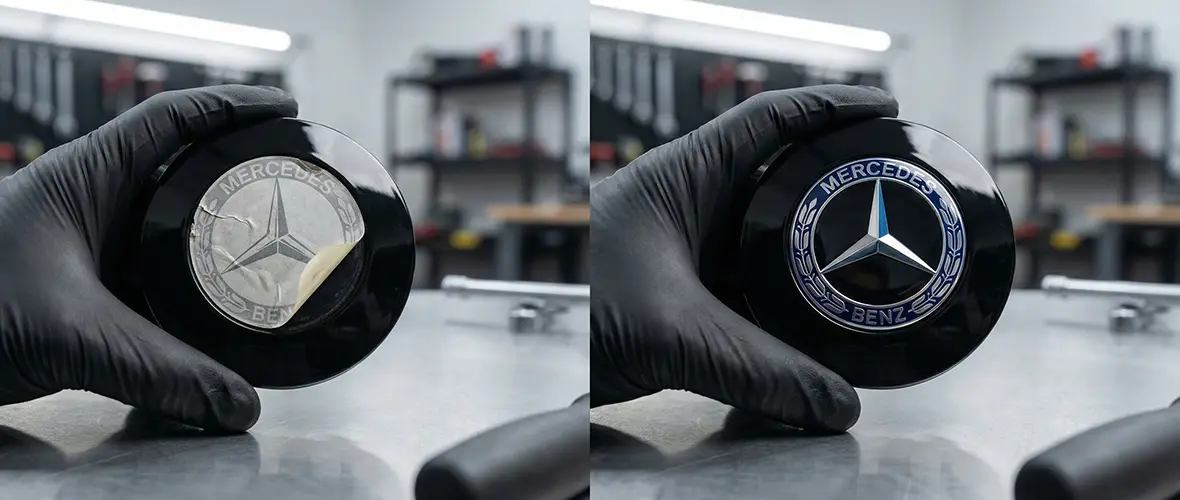
A domed resin layer acts like a clear shield over the print. It adds thickness, it takes surface scratches, and it keeps brake dust from grinding directly into the ink. It also seals the printed layer so the edge stays cleaner over time. On a wheel, that protection matters more than people think because the cap gets constant grime and wash contact.
There is another honest reason I like domed emblems. They look like factory badges, not like a flat label. Light hits the curved surface and the colors look deeper, even from a few feet away. If you care about a clean OEM style look, domed is the shortest path. Paper can never look like that or last like that, which is the whole point of skipping paper.
How to make UV stickers last longer
Even great materials can be ruined by bad prep. I once rushed a set of caps after using tire shine, then wondered why the edge lifted a week later. That was oil on the surface, not a bad sticker. Adhesives hate oil, and wheels are always oily from road film and detailing products. Clean beats hope every time.
Do this and you will get more life out of any good decal:
Wash the cap with soap and water, then dry it fully.
Wipe with isopropyl alcohol, then let it dry before you touch it again.
Apply when the cap is mildly warm, not freezing cold.
Press from the center out, then press the edge hard all the way around.
Let it sit before a hard wash or a long highway run.
If you want the full step by step with the exact moves, read How to Prep Wheels So Stickers Never Fall Off. Prep is the boring part, but it decides if the edge stays sealed. A sealed edge keeps water from creeping under, which also keeps grime from staining the glue line. Once the edge is sealed, UV becomes the slower enemy instead of the fast one. That is how you win.
Why we build ours this way
Most people who buy wheel stickers want the simple win, make the wheels look clean for years, not weeks. That is why we avoid paper and focus on vinyl plus protection, because wheels are harsh and they expose weak materials fast. It is also why we push simple, bold designs, since tiny lines vanish under brake dust and make people think the sticker faded. Sometimes the sticker is fine, the design was just too busy for a dirty wheel. I would rather give you a design that stays readable.
If you want a clear example of the build, look at Wheel Sticker Logo Epoxy Dome Edition. It is made as an emblem with a domed protective layer, not as a bare printed label. Another good reference is Sticker dome Premium Edition Custom Badges for Cars, which lays out materials and durability features up front. Compare those details to a paper label listing and the gap is obvious. You can feel it in your hand, not only read it on a page.
And if you want to design your own badge, DIY Custom Wheel Sticker Design, Make Your Own Emblem is the guide I point people to. Good sizing and bold shapes help you keep the “new” look longer. When a design stays readable while dirty, it feels like it lasts longer too. That is a small trick, but it matters. It also helps you avoid tiny details that turn into gray mush.
Common myths that waste money
The myths sound harmless until you see the same failures again and again. Wheels are a harsh test, so the truth is blunt. If you buy based on wishful thinking, you buy twice. I would rather you buy once and be done. Here are the myths I want you to forget:
“Waterproof is enough,” UV can drive a big share of fading damage.
“Clear tape protects it,” tape yellows and lifts and traps grime.
“More heat is always better,” too much heat can stretch film and stress the edge.
“If it fades, it is always the seller,” some pigments fade faster by nature.
FAQ
Q: Why do my car stickers fade in the sun so fast?
A: UV breaks down the bonds in inks and pigments, and heat speeds that breakdown up. A protective top layer and outdoor grade pigments slow fading a lot.
Q: Are paper stickers ever OK on a car?
A: Yes, inside the cabin or on clean plastic parts that stay dry and cool. Wheels and exterior trim get wet, hot, and gritty, and paper swells and shrinks until the edge lifts.
Q: What makes fade resistant decals different?
A: Better face films like vinyl, better inks, and a protective layer, plus an adhesive meant for exterior use. Vinyl constructions are designed as a system, face material plus adhesive plus liner.
Q: Do domed resin emblems help with UV or is it only looks?
A: The dome protects the print from abrasion and seals the surface so grime does not grind directly into the ink. It also helps the badge keep that deep factory look longer.
Q: What is the best way to get the longest life from UV stickers on wheels?
A: Prep the surface, press the edge hard, and avoid harsh brush washes. Flatter angles take more direct sun, so shade helps when you can.


