

Center Cap Sizes. The Chart for VW, Audi, and BMW
So, you bought some new center caps online. You waited three days for shipping. You finally ripped open the package, walked out to your driveway, squatted down by your wheels, and... pop.
They didn’t fit. Maybe they were too loose and rattled like a maraca. Maybe they were too big and you tried to jam them in with the palm of your hand until you bruised your skin. Either way, you are standing there with a car that still looks incomplete and a set of plastic circles that are useless.
I see this every single week at the shop. People think a center cap is just a center cap. They think, "I drive a BMW, so I need BMW caps." If only it were that simple. The truth is, manufacturers change these sizes like they change their socks. A 3-Series from 2005 does not use the same cap as a 3-Series from 2020. And if you have aftermarket wheels? All bets are off.
You don't need to guess anymore. I’m going to walk you through the sizes for the big three German brands—VW, Audi, and BMW—and then I’m going to teach you how to measure so you never waste money on return shipping again.
The Short Answer: You Need to Measure
I know you want a simple list. I will give you the charts below. But hear me out first. A chart is a guide. It is not the Bible. I have seen "stock" wheels that were swapped by the dealership before the first owner even drove it off the lot. I have seen replicas that look exactly like OEM wheels but have a center bore that is 2mm smaller.
If you take nothing else away from this, remember this: Trust the ruler, not the year of your car.
With that warning out of the way, let's look at the numbers. These are the most common sizes you will run into.
BMW Center Cap Sizes
BMW is usually pretty good about sticking to a standard, but when they switch, they switch hard. For decades, if you saw a BMW, it had the same size cap. Then, the new chassis came out and confused everyone.
The "Standard" 68mm Cap
For the vast majority of BMWs built between the 1990s and roughly 2017, the magic number is 68mm. This is the holy grail of BMW caps. If you have an E46, E90, E60, or even an early F-chassis, you are likely looking for a 68mm cap. It usually has 10 pins on the back and a wire tension ring.
- Most 3-Series (E36, E46, E90, F30): Usually 68mm.
- 5-Series (E39, E60, F10): Usually 68mm.
- X5 (E53, E70): Usually 68mm.
The New 56mm Cap
Then came the G-chassis. Around 2018 (depending on the model), BMW decided 68mm was too big. They shrunk the bolt pattern from 5x120 to 5x112 (like Audi and VW), and they shrunk the center cap to 56mm.
This catches so many people off guard. If you trade in your 2015 3-Series for a 2020 3-Series, your old custom caps will not fit. They will fall right off. The 56mm cap is cleaner, smaller, and flush-mounted.
- G20 3-Series: 56mm.
- G30 5-Series: 56mm.
- Newer X3, X5, X7: 56mm.
The "Weird" Sizes
Occasionally, you will find an oddball. Some really old vintage BMW wheels (like E30 basketweaves) use a huge locking cap that is essentially the whole center of the wheel. Those aren't really "caps" in the modern sense; they are hub covers. And some aftermarket wheels made for BMWs might use a 70mm or 60mm bore just to be difficult.
VW Center Cap Sizes
Volkswagen is the wild west compared to BMW. Because VW shares parts with Audi, Skoda, and Seat, their bin of parts is massive. You really need to check your specific rim here.
The Big Three VW Sizes
Generally, you are going to run into one of these three diameters:
- 55mm / 56mm: This is very common on newer stock wheels. It’s small and usually has a very flat face.
- 65mm: This is the classic size for many MK5 and MK6 Golfs, Jettas, and Passats. If you have a wheel from around 2010, start by checking if it's 65mm. The face of these caps is often curved or "domed" quite a bit.
- 70mm - 76mm: The Touareg and some Transporter vans use massive caps. They have big hubs to support the weight of the truck. Do not try to stick a Golf cap on a Touareg. It will look like a button on a grand piano.
One specific thing to watch with VW is the clip length. VW wheels often have different thicknesses at the center bore. You might find a cap that is the perfect 65mm diameter, but the clips are too short to grab the ledge inside the wheel. If that happens, you might need to use a sticker instead of a full replacement cap.
Audi Center Cap Sizes
Audi likes to be fancy. They don't just use round caps; they use "star" caps that cover the lug nuts on many models. If you have the spider/star cap, you are buying a specific part number, not a generic size.
The Round Caps
If your Audi wheel has exposed lug nuts and a small center cap in the middle, it is likely one of these:
- 60mm: Very common on mid-2000s Audis (A4 B6/B7).
- 68mm / 69mm: Used on many OEM wheels for the A5, A6, and Q5 lines.
- 135mm+ (Star Caps): These are the big plastic covers that hide your bolts. You cannot replace these with a simple round cap unless you change the wheel. However, the center of that star cap is often removable, and that little insert is usually 56mm or 60mm.
If you want to change the look of those big star caps, your best bet is often to just replace the emblem in the middle. You can get Center Wheel Emblems that stick right over the old, faded Audi rings.
How to Actually Measure (The Right Way)
Okay, put the charts away. Let's get your hands dirty. You need to measure your actual wheel to be 100% sure. I cannot tell you how many guys come into the shop with "stock" wheels that turn out to be replicas from eBay. Replicas rarely use the same cap size as the real deal.
Tool of Choice: The Caliper
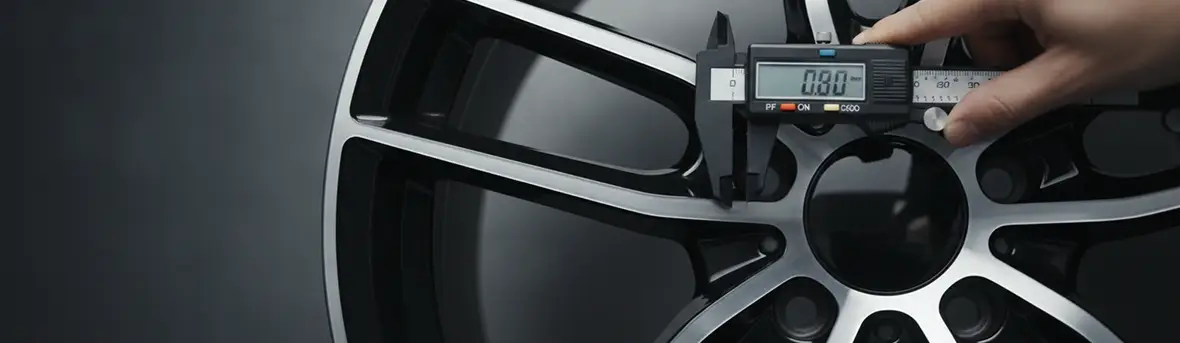
Do not use a tape measure. A tape measure is for building a deck. It is not for measuring a millimeter difference in a plastic clip. You need a digital caliper. You can buy a cheap plastic one for $5 at a hardware store. It is worth it.
Step 1: Pop the Old Cap
You need the hole empty. Take a flathead screwdriver, wrap the tip in masking tape (so you don't scratch your fancy rims), and gently pry the old cap out. If you can, it's safer to take the wheel off and poke it out from the back with a screwdriver handle.
Step 2: Measure the Hole (Outer Diameter)
Take your caliper and measure the hole in the wheel from edge to edge. This is the Outer Diameter (OD). This number tells you how big the face of the cap needs to be to cover the hole and look smooth.
- If the hole is 68mm, you buy a 68mm cap.
- If the hole is 56mm, you buy a 56mm cap.
Step 3: Measure the Inner Lip (Inner Diameter)
This is the tricky part. Look inside the hole. There is a little ridge or groove where the plastic clips snap in. That diameter is smaller than the face. This is the Inner Diameter (ID).
If you buy a cap with the right face size but the wrong clip size, it won't snap in. It will just sit there loose, or it won't fit at all. Most sellers will list both numbers, like "68mm Face / 65mm Clip".
Step 4: Check the Clip Depth
This is for the advanced class. Some wheels are thick; some are thin. If the clips on your new cap are only 3mm long, but the groove in your wheel is 5mm deep, the clips won't reach the ledge. They won't lock. If you are unsure, longer clips are usually safer because they can flex, but too long and they will stick out. If you have this problem, I usually recommend switching to a Domed Sticker instead of a full cap.
Why "Domed Stickers" Are a Mechanic's Secret Weapon
Sometimes, you just can't find a cap that fits. Maybe you have vintage wheels from 1985. Maybe you have obscure aftermarket rims from a company that went out of business. Maybe the previous owner bored out the center hole with a Dremel tool (I have seen it happen).
In these cases, stop trying to find a plastic clip-in cap. You are chasing a ghost. The solution is HubCapStickers.
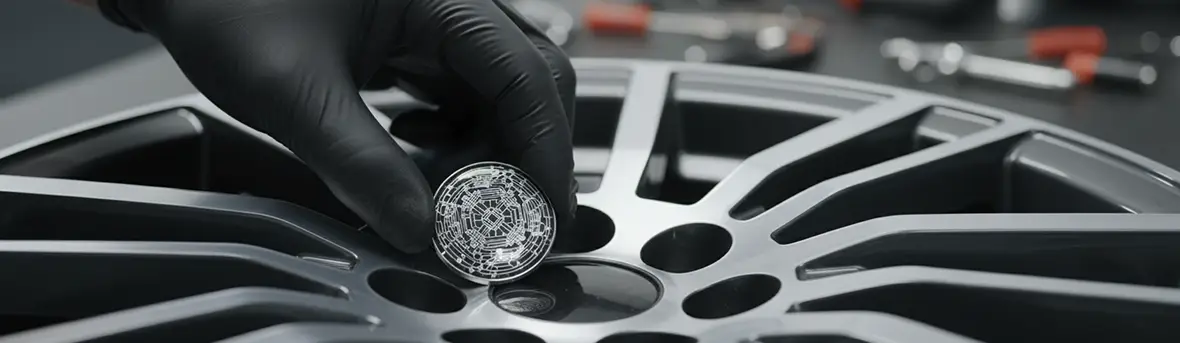
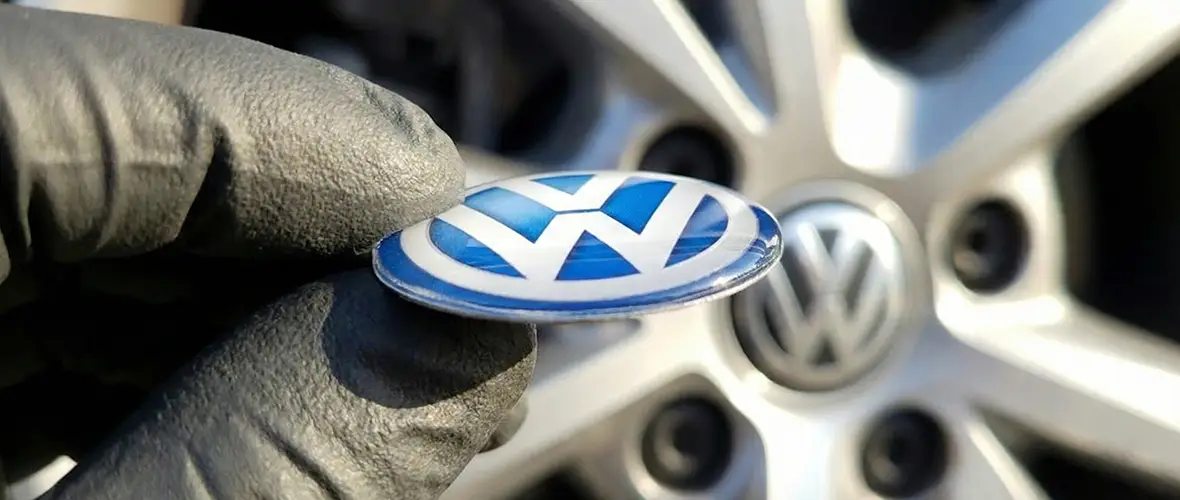
A domed sticker is a thick, resin-coated decal. It isn't a flat piece of paper. It has a 3D bubble of clear resin over the top. This does two things:
- It looks like OEM: The resin gives it that glass-like shine that factory badges have.
- It is durable: The resin protects the print from UV rays, salt, and brake dust.
- It fits anything: You don't need to worry about clips. You just measure the flat surface of your existing cap (or a generic blank cap), peel, and stick.
I use these all the time for custom projects. If a guy wants a black-and-white BMW logo on a wheel that only accepts a weird 62mm cap, I just buy a blank 62mm cap and slap a high-quality domed sticker on it. It looks factory fresh.
Common Mistakes to Avoid
I want to save you the headache of returning parts. Here are the ways I see people mess this up.
Mistake 1: Ignoring Aftermarket Wheels
If your wheels say "Vossen," "Rotiform," or even "Replica" on the back, the factory BMW or Audi chart means nothing. Aftermarket wheel companies make their center bores whatever size they want. Usually, they are generic sizes like 60mm or 70mm, and they use centering rings to fit the car hub. You must measure the hole on these wheels.
Mistake 2: Measuring the Old Worn-Out Cap
If your old cap fell off, it probably shrank or the clips broke. Measuring a broken part is a bad idea. Always measure the wheel hole itself. The wheel doesn't change size; the plastic cap does.
Mistake 3: Forgetting the Convex Curve
Some caps are flat. Some are domed (convex). If your wheel spokes curve outward, a flat cap might look sunken in. If your wheel is flat, a super-domed cap might look like a pimple. Look at the profile of your wheel before you buy.
Mistake 4: Buying Cheap Paper Stickers
Do not buy thin vinyl stickers for your wheels. They will peel off after one car wash. Brake dust is hot and corrosive. You need the thick, resin-coated domed kind. They are the only ones that survive the heat of a brake rotor.
FAQ: Mechanic's Quick Answers
Q: Can I put 68mm caps on my new BMW G20?
No. The new G-chassis uses 56mm caps. The 68mm ones are huge compared to the new hole. They won't even start to fit.
Q: My caps are loose. Can I fix them without buying new ones?
Sometimes. You can try the "electrical tape trick." Wrap a layer or two of electrical tape around the plastic clips of the cap to make the diameter slightly wider. It’s a temporary fix, but it can stop the rattling. Just don't expect it to last forever.
Q: How do I remove the old glue if I'm replacing just the sticker?
Use Goo Gone or a similar citrus cleaner. Soak it for five minutes. Then use a plastic razor blade or your fingernail. Do not use a metal screwdriver to scrape glue off; you will gouge the plastic.
Q: Do these stickers stay on in a car wash?
If you prep the surface, yes. You must clean the area with rubbing alcohol before you stick them on. If there is any wax or brake dust, the adhesive won't bond. If you clean it right, you'll need pliers to get them off later.
Accurately measuring your wheel center bore is crucial for a perfect fit, as even a millimeter difference can prevent installation. Use this reference chart to identify the correct BMW center cap size for your specific chassis, as well as standard specifications for Volkswagen and Audi models.
| Car Brand | Cap Size (Outer Diameter) | Platform / Bolt Pattern | Compatible Models & Notes |
|---|---|---|---|
| BMW | 68 mm | 5x120 (Older Standard) | Most E-Chassis & F-Chassis models. Includes: 3 Series (E36, E46, E90, F30), 5 Series (E39, E60, F10), X5 (E53, E70, F15). |
| BMW | 56 mm | 5x112 (Newer Standard) | Most G-Chassis & modern FWD platforms. Includes: 3 Series (G20), 5 Series (G30), X3 (G01), X5 (G05), X1 (F48), X2 (F39). |
| Volkswagen | 55 mm / 56 mm | Older Generations | Common on Golf Mk3, Golf Mk4, Jetta (older), Polo. Part Ref: 1J0 601 171 |
| Volkswagen | 65 mm / 66 mm | Modern Standard | Standard for Golf Mk5, Mk6, Mk7, Passat B6/B7, Tiguan, CC. Part Ref: 3B7 601 171 |
| Volkswagen | 70 mm / 76 mm | Large SUV | Specific to VW Touareg models (varies by year). |
| Audi | 60 mm / 61 mm | Legacy / Compact | Older A3, A4 (B6/B7), A6 (C5), TT Mk1. Part Ref: 4B0 601 170 |
| Audi | 68 mm / 69 mm | Modern Standard | Current A3, A4 (B8/B9), A5, A6, Q3, Q5, Q7. Part Ref: 4B0 601 170 A |
| Audi | 135 mm | "Star" / Spider Cap | Distinctive star-shaped cap covering lug bolts (A4, A6, A8, RS4). |
Make Your Wheels Look Right
There is nothing worse than a nice car with missing center caps. It looks like you parked in a bad neighborhood and someone stole them. It’s a $20 or $30 fix that makes your car look brand new again.
Go out to your garage. Take your caliper. Measure that hole. Once you have the number—whether it's the classic BMW 68mm, the new 56mm, or some weird VW size—you can find exactly what you need.
If you want to browse some options or find custom colors that the dealership won't sell you, check out the Hubcap Stickers Blog for more ideas or head straight to the shop. Don't let your wheels drive around naked.